Introducing PSM.ai: A Curated Knowledge Platform for Artificial Intelligence in Process Safety
Executive Summary
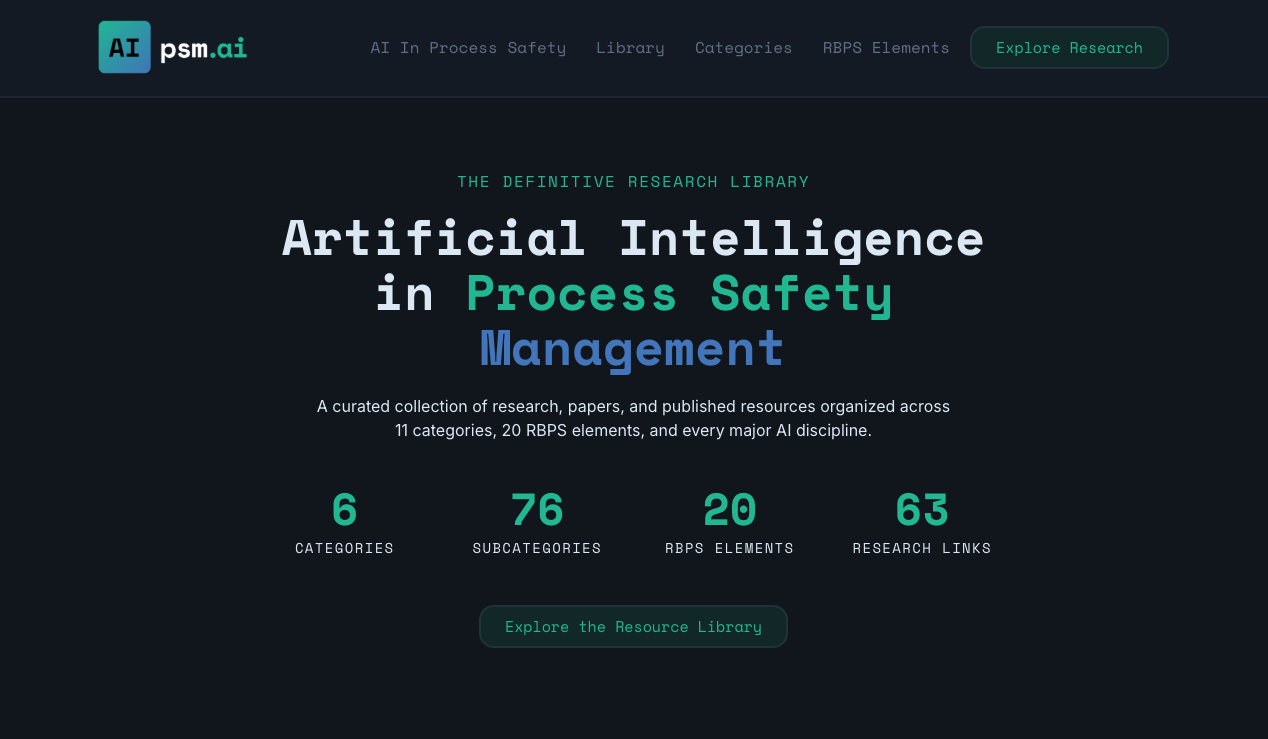
PSM.ai is a curated knowledge platform dedicated to the application of artificial intelligence in process safety. It brings together peer-reviewed research, technical papers, and emerging industry perspectives into a structured, vendor-neutral resource aligned with Risk-Based Process Safety (RBPS) principles.
As interest in AI accelerates across safety-critical industries, organizations face a growing challenge: distinguishing meaningful, engineering-grade applications from general-purpose automation and hype. PSM.ai addresses this gap by organizing research and insights across hazard identification, incident investigation, management of change, and other core safety disciplines.
Developed and maintained by Gateway Consulting Group, the platform reflects decades of practical experience in process safety management systems and digital transformation. Its purpose is not to promote specific tools, but to support informed decision-making, technical rigor, and responsible adoption of AI within established safety frameworks.
The Growing Role of AI in Process Safety
Artificial intelligence is rapidly entering industrial environments. From predictive maintenance to document analysis and decision support, the potential applications are significant.
However, process safety is not a typical digital domain. It is governed by:
- Established engineering principles
- Regulatory expectations
- High consequences of failure
This creates a fundamental tension. While AI offers new capabilities, its use in process safety must be carefully evaluated within the context of risk, accountability, and system integrity.
Organizations are increasingly asking:
- Where can AI be applied safely and effectively?
- Which use cases are mature, and which are still experimental?
- How does AI align with existing PSM and RBPS frameworks?
These are not trivial questions—and they are not well answered by generic AI discussions.
The Problem: Fragmented and Unstructured Information
One of the biggest barriers to adopting AI in process safety is not technology—it is information fragmentation.
Relevant research exists across:
- Academic journals
- Conference proceedings
- Industry white papers
- Emerging technical blogs and forums
But this information is:
- Scattered across sources
- Inconsistent in quality
- Difficult to interpret in a process safety context
Even experienced practitioners can struggle to connect AI techniques with practical safety applications such as:
- Process Hazard Analysis (PHA)
- Management of Change (MOC)
- Incident investigation
- Asset integrity and reliability
Without structure, organizations risk either ignoring valuable innovations or adopting approaches that are not yet appropriate for safety-critical use.
The Solution: A Structured, Vendor-Neutral Knowledge Platform
PSM.ai was created to address this gap.
The platform organizes content across three primary dimensions:
1. Risk-Based Process Safety (RBPS) Elements
Research is mapped to the 20 RBPS elements, including:
- Hazard Identification & Risk Analysis
- Incident Investigation
- Management of Change
- Asset Integrity & Reliability
- Management Review & Continuous Improvement
This allows users to quickly understand where AI is being applied within the CCPS risk-based process safety framework.
2. Technical Categories and Methods
Content is grouped by AI discipline, such as:
- Machine Learning
- Natural Language Processing (NLP)
- Generative AI
- Knowledge extraction and document analysis
This provides clarity on how AI is being implemented, not just where.
3. Curated Research Library
At its core, PSM.ai is a growing library of:
- Peer-reviewed papers
- Conference publications
- Technical studies
Each entry is selected based on:
- Relevance to safety-critical industries
- Analytical depth
- Independence from commercial bias
What the Research Is Telling Us
One of the most important insights emerging from the curated library is this:
Most AI research in process safety today is concentrated in a few key areas.
Specifically:
- Incident investigation and accident data analysis
- Hazard identification and risk modeling
- Reliability prediction and asset performance
These are domains where large datasets exist and where AI techniques can be applied with measurable outcomes.
At the same time, there are notable gaps.
Very little research currently addresses AI in:
- Management of Change (MOC)
- Operating procedures
- Safety culture and workforce engagement
- Emergency management
This imbalance is important. It highlights both:
- Where AI is most mature today, and
- Where future innovation is needed
A Practical Perspective: AI as an Augmentation Tool
A consistent theme across the research—and from practical experience—is that AI should be viewed as an augmentation tool, not a replacement for engineering judgment.
In process safety, this means:
- Supporting engineers in identifying hazards
- Assisting in analyzing large volumes of data
- Improving access to process safety information
- Enhancing consistency in decision-making
But not:
- Replacing formal hazard studies
- Automating critical approvals without oversight
- Removing accountability from qualified professionals
The integration of AI into process safety must remain aligned with the principles of discipline, verification, and control.
Gateway Consulting Group’s Role
PSM.ai is curated and maintained by Gateway Consulting Group as part of a broader commitment to advancing process safety through structured, engineering-based approaches.
Gateway’s involvement is focused on:
- Organizing and curating content
- Providing technical context where appropriate
- Ensuring alignment with RBPS principles
The platform is intentionally positioned as vendor neutral. It is not a product offering, and it does not promote specific tools or solutions.
Instead, it reflects a belief that the industry benefits from:
A shared, structured understanding of how AI can—and should—be applied in process safety.
Looking Ahead
The application of artificial intelligence in process safety is still in its early stages. The technology will continue to evolve, but its success will depend on how well it is integrated into existing safety frameworks.
PSM.ai will continue to expand as new research and insights emerge, with a focus on:
- Maintaining technical rigor
- Highlighting practical applications
- Supporting informed decision-making
Explore the Platform
If you are interested in understanding how AI is being applied across process safety disciplines, we invite you to explore the platform:
Closing Thought
Artificial intelligence has the potential to enhance process safety—but only when applied with the same discipline and rigor that defines the field itself.
PSM.ai is intended to support that standard.