Artificial intelligence is no longer a future concept—it’s already influencing how high-hazard industries think about risk, data, and decision-making.
But here’s the problem:
Most discussions around AI are either too technical to follow or too superficial to be useful.
For process safety professionals, neither is acceptable.
Why This Matters Now
Over the last few years, tools powered by Generative AI and Large Language Models have moved from experimental to operational.
Yet in many facilities, there’s still uncertainty around:
- What these technologies actually do
- Where they fit within PSM programs
- Whether they can be trusted in safety-critical environments
This gap between capability and understanding is now a real operational risk.
A Practical, Engineering-Focused Explanation
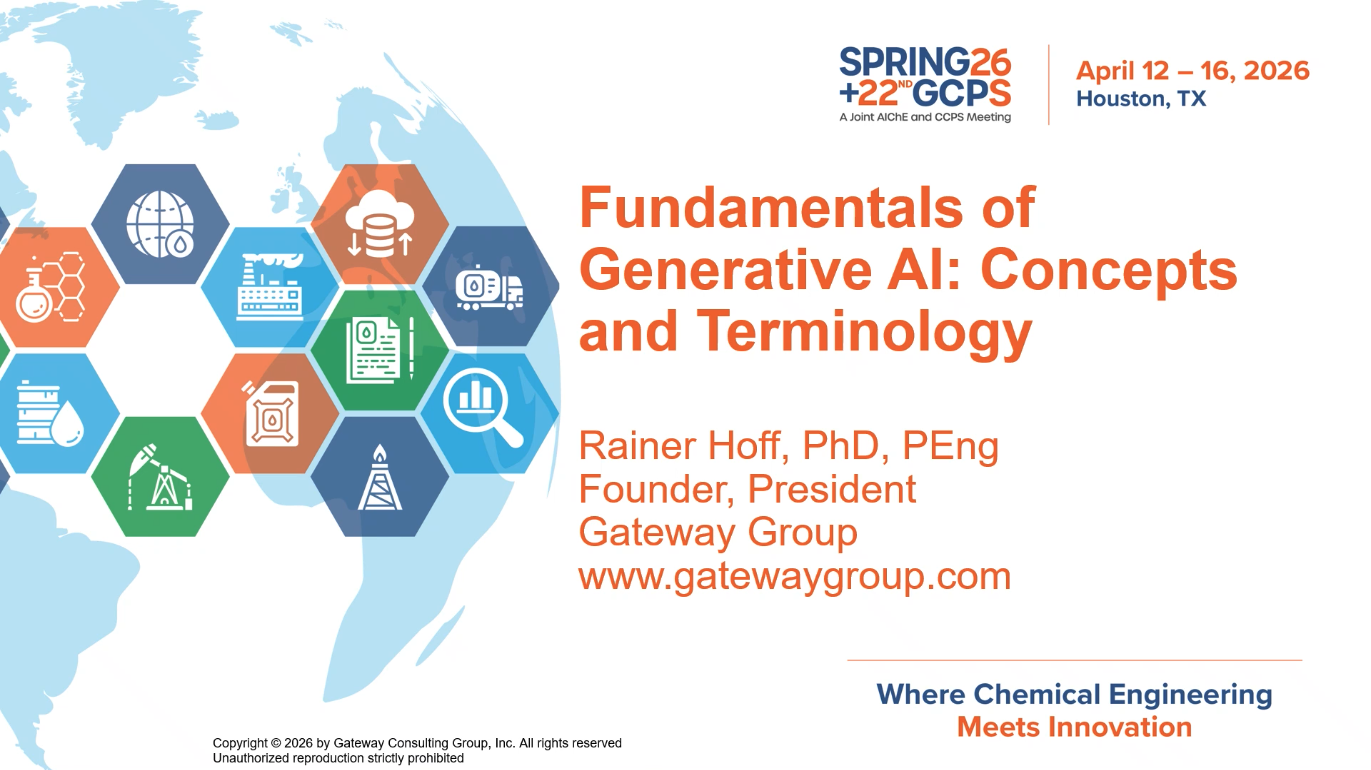
The featured presentation “Fundamentals of Generative AI: Concepts and Terminology” was developed by Dr. Rainer Hoff, president of Gateway Consulting Group for the AIChE 2026 Global Congress on Process Safety and was developed specifically to address that gap.
Rather than focusing on hype, it walks through:
- What “intelligence” actually means in an AI context
- How AI evolved from rule-based systems to modern models
- The difference between machine learning, NLP, and generative systems
- Why transformer architectures changed everything
- How outputs are generated—and where uncertainty comes from
And importantly:
It connects these concepts back to real process safety scenarios.
From Theory to PSM Reality
One of the most valuable aspects of the presentation is how it grounds AI concepts in familiar engineering problems.
For example:
- Determining whether a change is Replacement-in-Kind vs MOC
- Identifying patterns in incident data
- Understanding when probabilistic answers are acceptable—and when they are not
- Recognizing where deterministic tools (e.g., calculations, LOPA, relief sizing) are still essential
This is not abstract AI discussion.
It’s directly aligned with how safety professionals think about risk, verification, and consequence.
The Critical Insight Most People Miss
A key takeaway from the presentation:
Generative AI does not “reason” like an engineer—it predicts patterns based on training data.
That distinction has major implications:
- Why outputs can appear authoritative—but still be wrong
- Why guardrails and validation are non-negotiable
- Why AI should augment—not replace—PSM judgment
Understanding this alone will change how your organization evaluates AI initiatives.
What You’ll Learn in 40 Minutes
If you invest the time to watch the full session, you’ll come away with:
- A clear mental model of how modern AI systems work
- The terminology needed to evaluate vendors and tools
- Practical insight into where AI fits—and does not fit—in PSM
- A foundation for integrating AI into systems like MOC, PHA, and PSI
Watch the Full Presentation
This is the extended 40-minute version of the session presented at the Global Congress on Process Safety.
If you’re serious about understanding AI in a way that is relevant, defensible, and applicable to high-hazard operations, it’s worth your time.
Final Thought
AI adoption in process safety will not be driven by technology alone.
It will be driven by professionals who:
- Understand the underlying concepts
- Recognize both capabilities and limitations
- Apply it responsibly within established safety frameworks
This presentation is a strong starting point for that journey.